
Solar and electrical contractor in Suffolk Park, NSW
Suffolk Park, from Tallow Beach to Broken Head Road
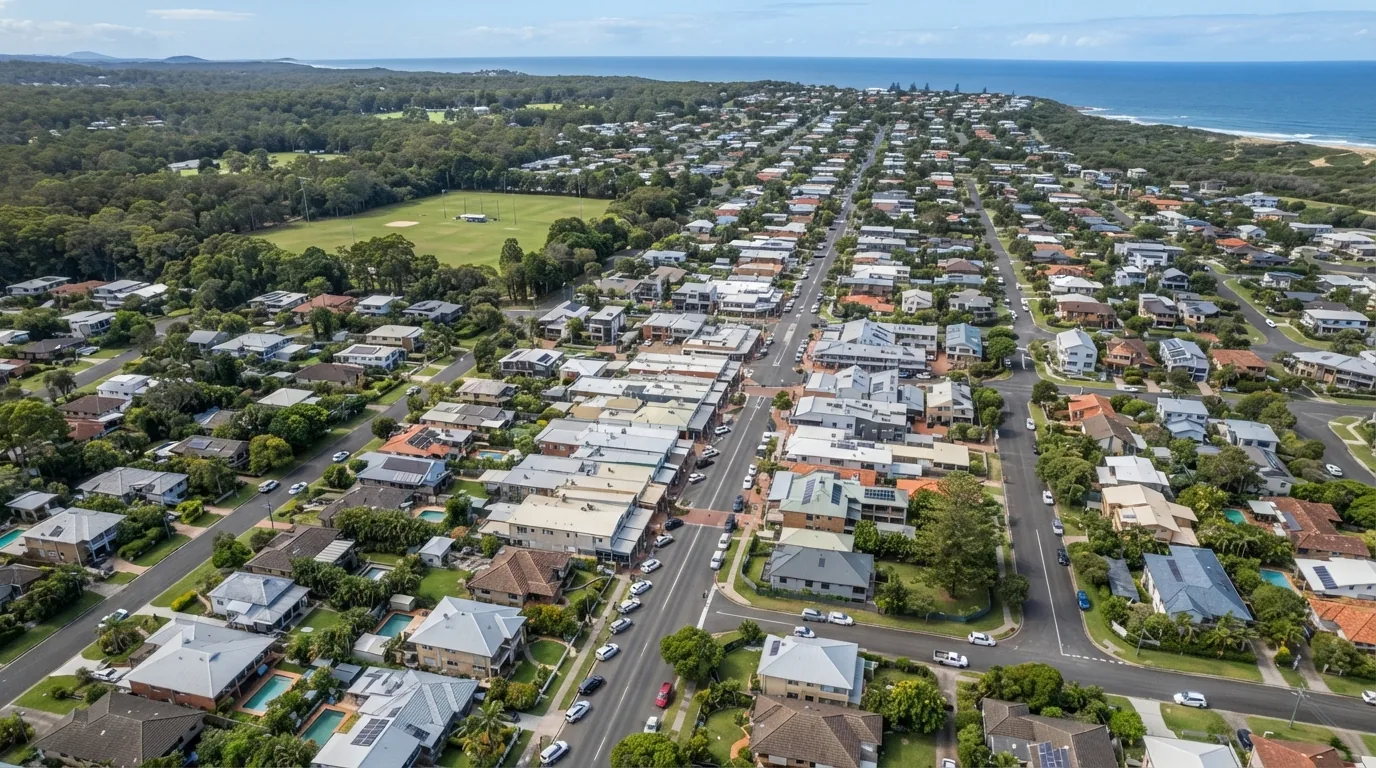
Suffolk Park runs along Tallow Beach about five kilometres south of Byron Bay. Broken Head Road is the spine, and the village shops sit at the corner of Clifford Street. Streets such as Alcorn Street run beside the dunes, while Baywood Chase and Byron Hills climb the slope behind. Between them lie bushland reserves, tea tree and coastal heath, and Tallow Creek runs out to the beach through Arakwal National Park. Most of the work is in houses rather than shops, and most of those houses can smell the sea.
Blocks here are a mix of beachside lots near Alcorn Street and quiet cul de sacs in Baywood Chase and Byron Hills. Driveways are often short and sealed, though some run down through bush to houses set back from the road. Meters sit on the front fence or the side of the house, and plenty of them take full sun and sand spray. Dogs and gates are common, so tell us about both. Street parking near the beach fills up on summer weekends.
Houses range from older timber and fibro beach homes near the dunes to brick and tile family homes in the planned estates. Roofs are mostly open to the sun, but tall coastal trees and the heath shade some of them, and the wind off the sea works on roof fixings. The council describes the Tallow Creek catchment as a flash flood catchment, so we look at how high the switchboard and any ground level equipment sit.
What we do here most
What Suffolk Park keeps needing
Houses with open roofs, salt air and sand in everything. Those three things shape most of the calls out here.
Solar
Fitting panels to a brick and tile estate house
In the cul de sacs behind Broken Head Road, a typical roof is large, tiled and faces more than one way. We check which slopes get the day's sun, how the roof is fixed and where the cable can run to the switchboard without opening up a finished ceiling. Tiles are lifted and replaced carefully, one at a time.
Batteries
Placing a home battery on a flood prone block
Parts of the suburb drain to Tallow Creek, which the council describes as a flash flood catchment. If a battery is wanted, where it sits matters as much as what it is. We look for a wall that stays dry, keeps clear of garden beds and is easy to reach, and we tell you plainly when the only spot is a poor one.
Repairs
Fixing corroded rails and isolators on a beachside roof
Systems within sight of the dunes can show rust on rails, clamps and the isolator beside the meter. Sand and damp can also get into outdoor junctions. We climb up, look at every fixing and connection, and report what has gone. Some parts swap in minutes, and some mean taking panels off. We say which once we have seen it.
Electrical
Wiring checks in an older timber house near dunes
Older timber and fibro houses by the beach can carry wiring from several eras, with old cable spliced into newer. Plastic goes brittle in roof heat and fittings corrode in the damp. We test, open the switchboard and report what we find, then plan the work room by room, keeping the house usable as we go.
If it is urgent
If the power drops in Suffolk Park after hours
- 1Look at the meter box and switchboard from outside, and note whether any switch is down. Do not open any cover.
- 2Leave alone anything wet or sandy, including outdoor power points, pool gear and any solar or battery equipment, and keep children and pets away from it.
- 3Tell us your street, whether you are near the dunes or up in the estates, and whether it rained or the surf was rough before the power dropped.
Common questions
Frequently Asked Questions
Which areas do you cover?
The Northern Rivers of New South Wales, from our base at Dorroughby, between Lismore and Byron Bay. Twenty places have their own pages on the service areas page, but they are a starting point rather than a boundary. If you are not sure we reach your address, call and we will check.
Do you answer the phone after hours?
Yes. The phone is answered at any hour, every day, on the number at the top of this page. Call with your address and what you are seeing, and we will tell you what to leave alone and what happens next.
Do you work on farms and businesses as well as homes?
Yes. The work runs from a single house roof to sheds, workshops, shops and farm buildings, on mains power and off it. Tell us what the building is used for and when it is busy, because that decides when the work can happen.
What should I send when I enquire?
A photo of your switchboard with the door open, a photo of the roof or the spot where equipment would go, and a recent power bill if you have one. If you already have a system, add a photo of the inverter and any error on its screen. Photos let us give you straight answers before anyone visits.
Will my solar keep working in a blackout?
A standard grid-connected system switches itself off when the grid goes down, even in full sun, and that is a safety feature. To keep some power on during an outage, the system needs a battery set up with a backup circuit. Which circuits go on that backup is decided with you before the work starts.
Can I add a battery to the solar I already have?
Often yes, but it depends on the inverter you have now and how the system is wired. Some inverters take a battery as it is, and others need replacing or adding to first. Send a photo of the inverter and we will tell you which it is likely to be.
What is the difference between grid-connected, hybrid and off-grid?
A grid-connected system works alongside the street supply and has no battery. A hybrid system uses one inverter to run the panels and a battery together. An off-grid system has no street connection at all, so the panels, battery and a backup generator input carry the whole property.
Can you work on a system someone else installed?
Yes. The first step is finding out exactly what is there, which means opening the switchboard, checking the cabling and reading what the inverter reports. After that we tell you what can stay, what should be repaired and what should be replaced.
Why does my solar system keep switching off or showing an error?
There are many possible causes, from a failing part to a loose connection or a fault on one string of panels. We trace the fault step by step and read the error codes before anything is replaced. Send a photo of the inverter screen and tell us when it happens.
What should I do if I see damage or smell burning near electrical equipment?
Keep clear of it and keep children and pets away. If there is fire or smoke, call emergency services first. Then call us, tell us what you saw and where, and leave the equipment alone until it has been checked.
Will the power go off while you work?
For most solar, battery and switchboard jobs the power is switched off for part of the day. We tell you when it will go off before we start, so you can plan around fridges, medical equipment and anything else that needs to keep running. Ask about it when you book.
Do you work on properties with no mains power?
Yes. Off-grid work starts with a list of what you run and when, because that decides the size of the panels, the battery and the inverter. We also look at the site itself, including shade, access and how far the equipment sits from the house.
Everything we do here
Services in Suffolk Park, NSW
The twenty things we do across the Northern Rivers all matter in Suffolk Park, where sand, salt air and quick creek flooding set the conditions for each of them.
Local, and on the phone
Tell us about your Suffolk Park house
Tell us your street and roughly how far the house is from the dunes. That one answer tells us how much salt air the equipment will see, and it shapes how we plan the visit.
0417 415 47424 hours a day, 7 days a week
Not urgent? Send us the job instead