
Solar and electrical contractor in Lismore, NSW
Working across Lismore, from the river up
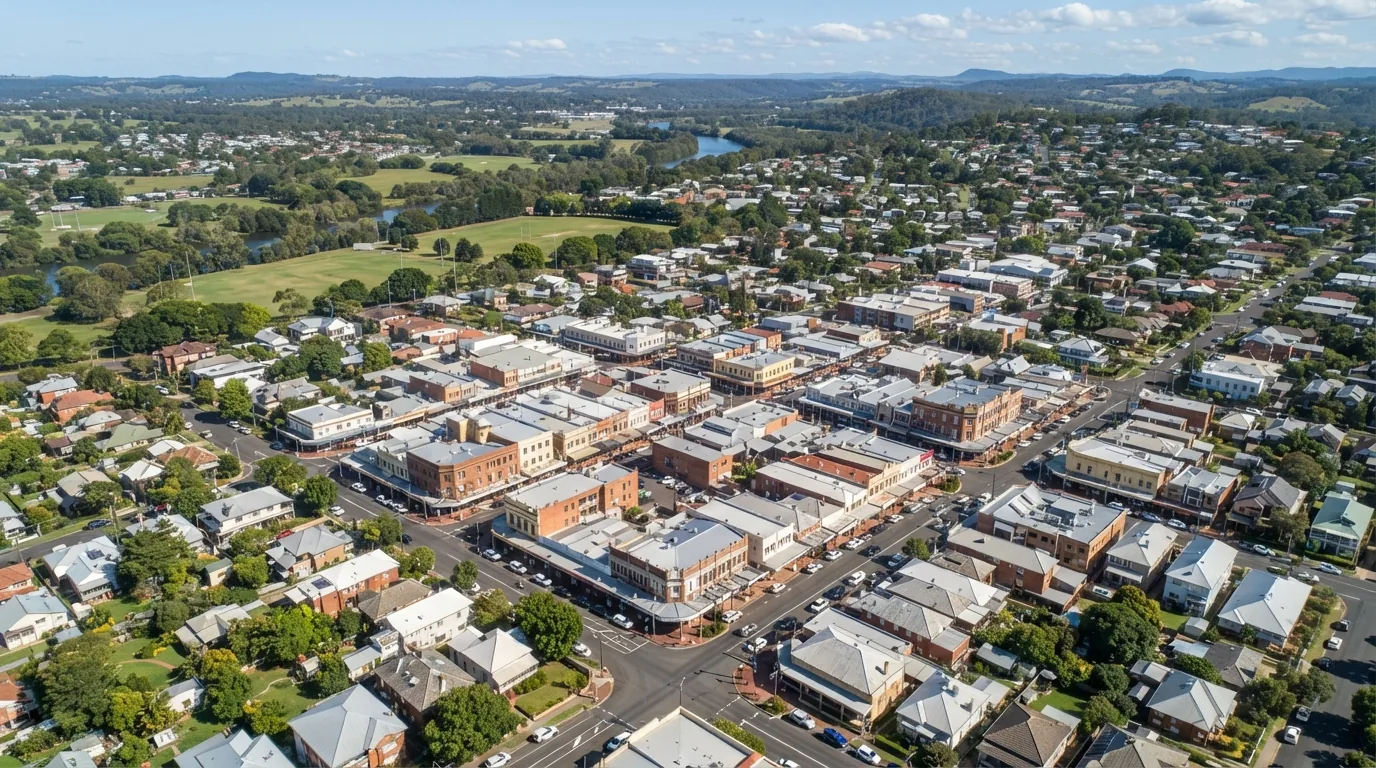
Lismore sits on a low floodplain where the Wilsons River meets Leycester Creek, and the work follows the shape of the town. The CBD runs along Molesworth Street, with shopfronts from the late 1800s and mid 1900s and arcades running through the blocks. Around it are the older inner suburbs of North Lismore, South Lismore and East Lismore, then Goonellabah further east. There are also industrial areas in South Lismore, East Lismore and Goonellabah, with sheds, workshops and showrooms along roads like Wyrallah Road and Ballina Road.
Access depends on which part of Lismore you are in. In the CBD, shops share a street frontage with little room behind, so ladders and equipment often go through a lane or a rear door, and we ask the owner or managing agent who holds the keys. Inner suburb houses usually have a driveway beside the house and a meter box on a front or side wall. Industrial sites have roller doors, moving forklifts and a main switchboard in a corner or plant room, so we ask who can let us in and when machines are running.
Many Lismore homes are high set weatherboard houses on posts, with living space upstairs and a ground level that has often been enclosed since for a garage or extra room. Floodwater in 2017 and again in 2022 rose well above ground level in the low parts of town, and the CBD levee was overtopped both times. That is a plain fact about the ground, and it changes the wiring work. Where a switchboard, meter, inverter or battery is fixed matters here, and higher up the wall or on an upper level is the sensible direction.
What we do here most
What Lismore buildings keep needing
Most Lismore calls come back to one question, which is how high the equipment sits and how much load the building carries. The four jobs below are the usual shapes of it.
Electrical
Moving a switchboard above flood height
In a low lying house the meter box and switchboard are often fixed on a ground level wall, which is the first place water reaches. We look at where the supply comes in, which wall is solid enough to take a board and how far the cables can be run upward. Some homes can move it upstairs and some can only go higher on the same wall. We tell you which, and why, before anything is quoted.
Commercial
Solar on a warehouse roof in South Lismore
A large shed roof with few shadows is a good place for panels, and a business that runs in daylight can use much of what they make. We start at the main switchboard, check what the roof sheeting and framing are made of, and ask which machines run when. Industrial sites often have three phase supply, which changes the inverter we choose and how it is connected.
Batteries
Battery and inverter upstairs in a high set house
When the ground level floods, a battery and inverter on the garage wall are exposed to it. In a high set house we look at the upper level, a landing wall or a verandah wall instead, and think about weight, ventilation and cable length. Not every house has a good spot, and we say so plainly. A battery also needs a clear way out for you to get to it safely.
Repairs
Testing wiring after water has been in a house
Wiring, power points and switchboards that have been under water cannot simply be switched back on once the house is dry. Silt and moisture sit inside fittings where you cannot see them. We test each circuit, replace what is damaged and tell you which parts we are not sure about. Solar inverters and batteries that were wet are checked separately and are not restarted until we have looked at them.
If it is urgent
If water or storm damage reaches your power in Lismore
- 1Look from a safe, dry spot and check whether water has reached the meter box, the switchboard or any power points, and whether the main switch sits above it.
- 2Do not switch anything back on, do not walk through water near wiring, and leave solar inverters, batteries and any soaked appliances alone. If you cannot reach the main switch while dry, leave it.
- 3When you call, tell us your street and which part of Lismore you are in, whether the house is high set or on a slab, how high the water got and where the meter box and switchboard are fixed.
Common questions
Frequently Asked Questions
Which areas do you cover?
The Northern Rivers of New South Wales, from our base at Dorroughby, between Lismore and Byron Bay. Twenty places have their own pages on the service areas page, but they are a starting point rather than a boundary. If you are not sure we reach your address, call and we will check.
Do you answer the phone after hours?
Yes. The phone is answered at any hour, every day, on the number at the top of this page. Call with your address and what you are seeing, and we will tell you what to leave alone and what happens next.
Do you work on farms and businesses as well as homes?
Yes. The work runs from a single house roof to sheds, workshops, shops and farm buildings, on mains power and off it. Tell us what the building is used for and when it is busy, because that decides when the work can happen.
What should I send when I enquire?
A photo of your switchboard with the door open, a photo of the roof or the spot where equipment would go, and a recent power bill if you have one. If you already have a system, add a photo of the inverter and any error on its screen. Photos let us give you straight answers before anyone visits.
Will my solar keep working in a blackout?
A standard grid-connected system switches itself off when the grid goes down, even in full sun, and that is a safety feature. To keep some power on during an outage, the system needs a battery set up with a backup circuit. Which circuits go on that backup is decided with you before the work starts.
Can I add a battery to the solar I already have?
Often yes, but it depends on the inverter you have now and how the system is wired. Some inverters take a battery as it is, and others need replacing or adding to first. Send a photo of the inverter and we will tell you which it is likely to be.
What is the difference between grid-connected, hybrid and off-grid?
A grid-connected system works alongside the street supply and has no battery. A hybrid system uses one inverter to run the panels and a battery together. An off-grid system has no street connection at all, so the panels, battery and a backup generator input carry the whole property.
Can you work on a system someone else installed?
Yes. The first step is finding out exactly what is there, which means opening the switchboard, checking the cabling and reading what the inverter reports. After that we tell you what can stay, what should be repaired and what should be replaced.
Why does my solar system keep switching off or showing an error?
There are many possible causes, from a failing part to a loose connection or a fault on one string of panels. We trace the fault step by step and read the error codes before anything is replaced. Send a photo of the inverter screen and tell us when it happens.
What should I do if I see damage or smell burning near electrical equipment?
Keep clear of it and keep children and pets away. If there is fire or smoke, call emergency services first. Then call us, tell us what you saw and where, and leave the equipment alone until it has been checked.
Will the power go off while you work?
For most solar, battery and switchboard jobs the power is switched off for part of the day. We tell you when it will go off before we start, so you can plan around fridges, medical equipment and anything else that needs to keep running. Ask about it when you book.
Do you work on properties with no mains power?
Yes. Off-grid work starts with a list of what you run and when, because that decides the size of the panels, the battery and the inverter. We also look at the site itself, including shade, access and how far the equipment sits from the house.
Everything we do here
Services in Lismore, NSW
These are the twenty things we do across the Northern Rivers, and in Lismore the flood height, the old shopfront buildings and the big industrial sheds shape most of them.
Local, and on the phone
Solar and electrical work in Lismore
Call or email with your street and suburb, and tell us whether the meter box and switchboard sit at ground level or higher up. That one detail decides what we bring and whether we plan to move anything. A photo of the meter box with the cover closed helps if you can send one.
0417 415 47424 hours a day, 7 days a week
Not urgent? Send us the job instead