
Solar and electrical contractor in Dorroughby, NSW
Dorroughby, up in the hills
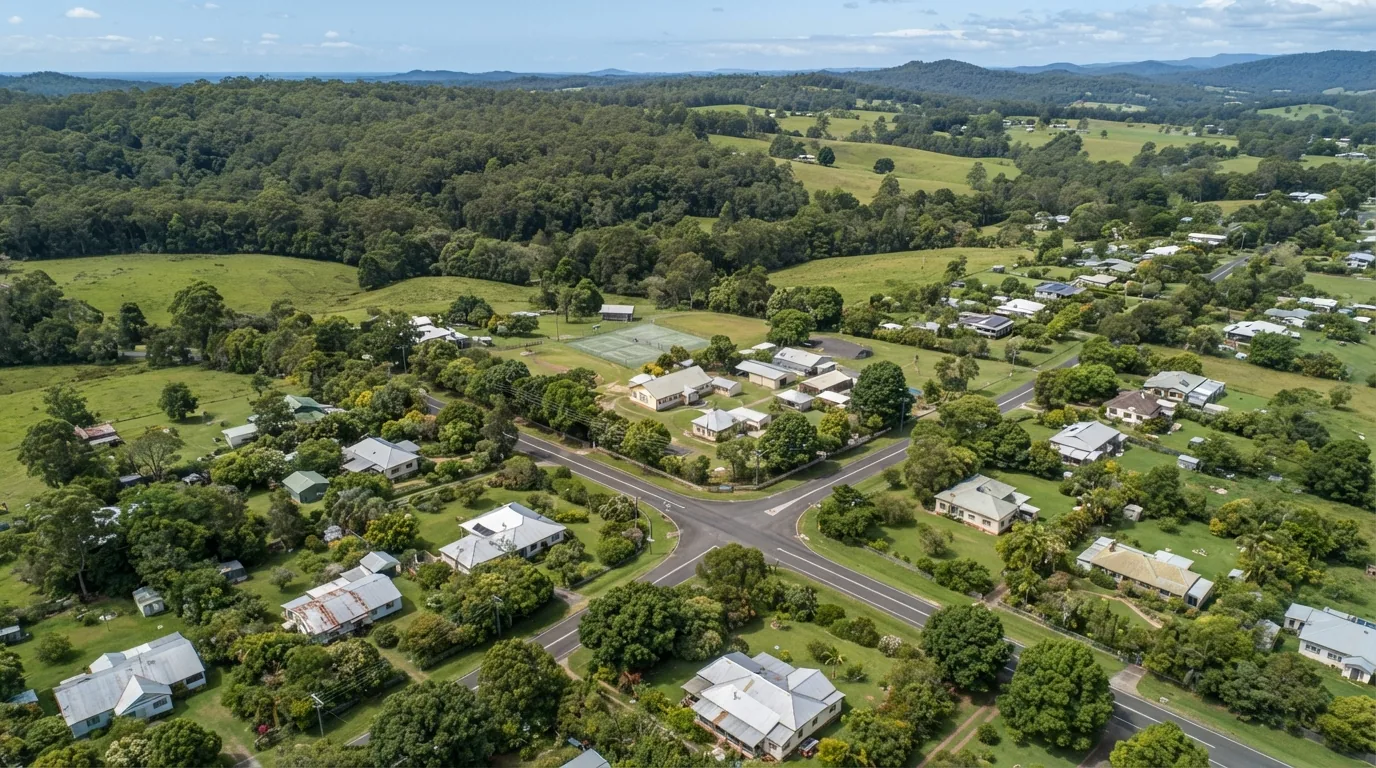
Dorroughby is a rural locality of about 160 residents on subtropical hills, around 190 metres above sea level, on the edge of Nightcap National Park and south of Rocky Creek Dam. There is no town centre to speak of, just Dunoon Road, Dorroughby Road and the lanes that run off them, with houses and sheds scattered across bush blocks and acreage. We are based in the hills nearby, and the work here is mostly on properties tucked in among trees.
Dorroughby driveways are the main thing to plan around. Many are long, steep and gravel, bordered by forest, with a gate or a cattle grid on the way. Meter boxes are often at the road, with a long run of cable up to the house, and the switchboard may be on a verandah, in a shed or on a post. We ask how long that run is and where the supply enters the property, because a long run changes what an inverter or a battery has to cope with. Clear directions beat a map pin.
Housing in Dorroughby is mostly houses on bush blocks and acreage, from older timber homes to owner built places and newer pole houses on slopes, with rainwater tanks and pumps on many of them. Tall trees close to a roof mean shade and falling leaves, and wet hill country is hard on cable joints and outdoor boxes. Where the line is a long way off and a branch can bring it down, a battery or a partly off grid setup is worth talking through.
What we do here most
What Dorroughby bush blocks keep needing
Properties in the hills depend on their own equipment more than most. The jobs below are about keeping it dry, shaded or cooled and working through the weather.
Off-grid
Sizing an off-grid system for a bush block
A house a long way from the pole can cost a lot to connect, and some owners choose to run on their own panels, batteries and a backup generator. We write down what is on the property, from the fridge to the water pump, and how much each uses on a wet week. The system is sized to that list, and we say what you may need to switch off in a long cloudy spell.
Inverters
Moving an inverter off a wet, shaded wall
An inverter fixed to a southern wall under dripping trees runs damp and cool, and damp is hard on its connections and the cable joints. We look at the wall, the weather it gets and how much air can move around the unit. A drier, better ventilated wall or a covered position can be better, and a new cable run may be needed to reach it.
Electrical
Rainwater tank pump on a long cable run
Many hill properties rely on a tank and pump for water, and the pump may be a long way from the house. A long run of thin cable loses voltage, and a pump that struggles to start can trip a circuit or wear out early. We measure the run, check the cable size and the protection, and fit what the pump and the distance need.
Solar
Ground mounted panels in a bush block clearing
When the roof sits in shade, a clearing a short walk away can be a better place for panels. A ground mount needs a firm, well drained footing, a cable run back to the house and a position that grass and regrowth will not shade within a year. We walk the clearing with you, mark the spot and show you how the cable would travel.
If it is urgent
If the power fails on a bush block in Dorroughby
- 1Look from a distance along the driveway and the lines from the road for a fallen branch, a broken or sagging line or a tree resting against a wire.
- 2Stay well clear of any fallen line and treat it as live, and leave your inverter, battery and switchboard alone if there is smoke, a burning smell or water running over them.
- 3When you call, tell us your road, the length and condition of your driveway, where the meter box and switchboard are, and whether you have tank water that depends on a pump.
Common questions
Frequently Asked Questions
Which areas do you cover?
The Northern Rivers of New South Wales, from our base at Dorroughby, between Lismore and Byron Bay. Twenty places have their own pages on the service areas page, but they are a starting point rather than a boundary. If you are not sure we reach your address, call and we will check.
Do you answer the phone after hours?
Yes. The phone is answered at any hour, every day, on the number at the top of this page. Call with your address and what you are seeing, and we will tell you what to leave alone and what happens next.
Do you work on farms and businesses as well as homes?
Yes. The work runs from a single house roof to sheds, workshops, shops and farm buildings, on mains power and off it. Tell us what the building is used for and when it is busy, because that decides when the work can happen.
What should I send when I enquire?
A photo of your switchboard with the door open, a photo of the roof or the spot where equipment would go, and a recent power bill if you have one. If you already have a system, add a photo of the inverter and any error on its screen. Photos let us give you straight answers before anyone visits.
Will my solar keep working in a blackout?
A standard grid-connected system switches itself off when the grid goes down, even in full sun, and that is a safety feature. To keep some power on during an outage, the system needs a battery set up with a backup circuit. Which circuits go on that backup is decided with you before the work starts.
Can I add a battery to the solar I already have?
Often yes, but it depends on the inverter you have now and how the system is wired. Some inverters take a battery as it is, and others need replacing or adding to first. Send a photo of the inverter and we will tell you which it is likely to be.
What is the difference between grid-connected, hybrid and off-grid?
A grid-connected system works alongside the street supply and has no battery. A hybrid system uses one inverter to run the panels and a battery together. An off-grid system has no street connection at all, so the panels, battery and a backup generator input carry the whole property.
Can you work on a system someone else installed?
Yes. The first step is finding out exactly what is there, which means opening the switchboard, checking the cabling and reading what the inverter reports. After that we tell you what can stay, what should be repaired and what should be replaced.
Why does my solar system keep switching off or showing an error?
There are many possible causes, from a failing part to a loose connection or a fault on one string of panels. We trace the fault step by step and read the error codes before anything is replaced. Send a photo of the inverter screen and tell us when it happens.
What should I do if I see damage or smell burning near electrical equipment?
Keep clear of it and keep children and pets away. If there is fire or smoke, call emergency services first. Then call us, tell us what you saw and where, and leave the equipment alone until it has been checked.
Will the power go off while you work?
For most solar, battery and switchboard jobs the power is switched off for part of the day. We tell you when it will go off before we start, so you can plan around fridges, medical equipment and anything else that needs to keep running. Ask about it when you book.
Do you work on properties with no mains power?
Yes. Off-grid work starts with a list of what you run and when, because that decides the size of the panels, the battery and the inverter. We also look at the site itself, including shade, access and how far the equipment sits from the house.
Everything we do here
Services in Dorroughby, NSW
These are the twenty things we do across the Northern Rivers, and in the Dorroughby hills long cable runs, shade from the forest and wet weather shape how we do almost all of them.
Local, and on the phone
Solar and electrical work in Dorroughby
Call or email with your road name and tell us roughly how far the house is from the meter box at the road. That distance decides the cable, the inverter and the battery we talk about first. A photo of the driveway entrance and meter box would help too.
0417 415 47424 hours a day, 7 days a week
Not urgent? Send us the job instead