
Solar and electrical contractor in Bangalow, NSW
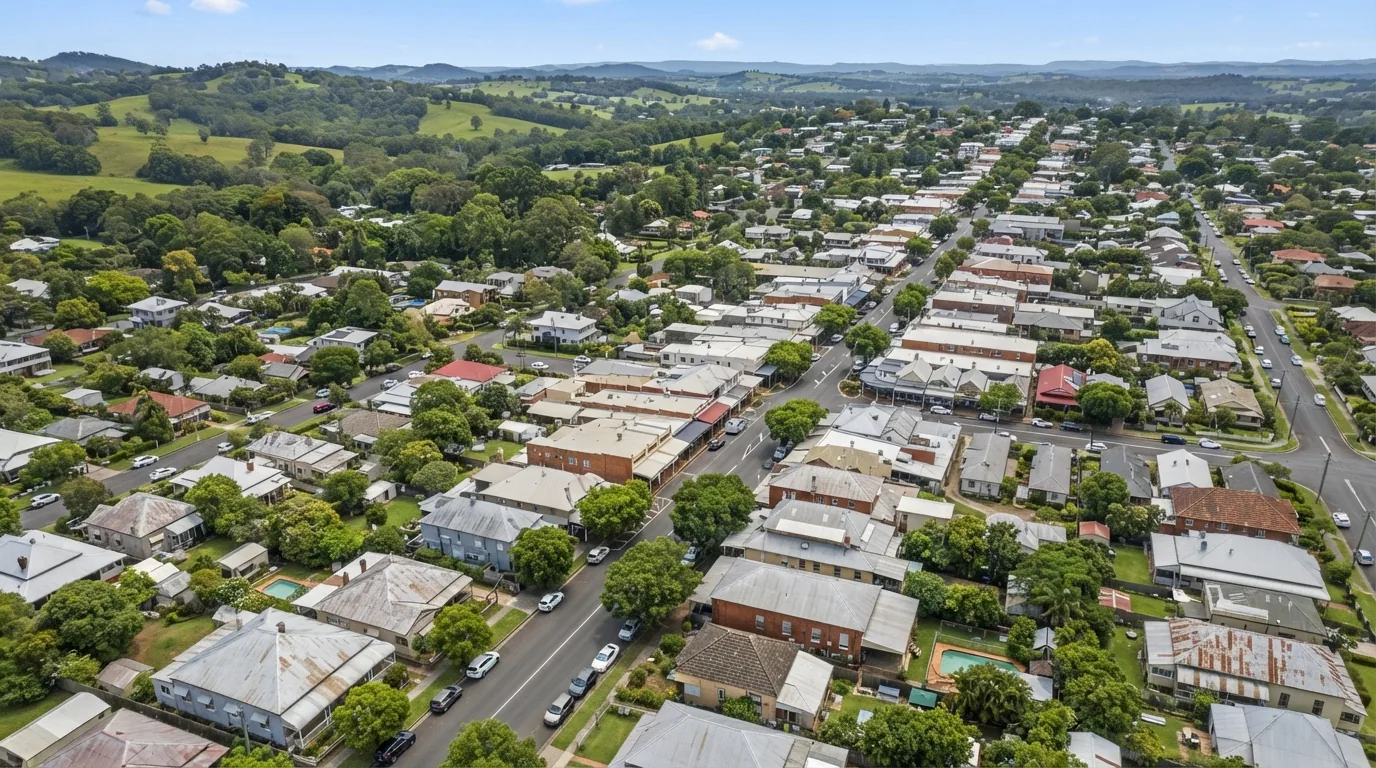
Bangalow, from Byron Street up into the hills
Bangalow is an old hinterland village, about fourteen kilometres inland from Byron Bay. Byron Street is the main street, lined with Federation shops, a hotel, a post office and cafes, and a good part of the village is a heritage conservation area under the Byron local environmental plan. The work splits two ways. One half is in the village, in shops and character houses. The other is out on the rolling country around it, where houses sit back on larger lots.
Shopfront work happens around trading hours, and Saturday mornings are the busiest because of the farmers market. Village streets are narrow, so tell us if the only way in is through a lane. Older houses often have the meter on a side wall and the switchboard on a verandah or in a back room. On the hill blocks, driveways can be steep and rough, and a gate or a creek crossing along the way is not unusual.
Housing is what sets Bangalow apart. Queenslander style timber houses on stumps, Federation cottages with high ceilings and tin roofs, and verandahs on two or three sides all mean old wiring, hard cable routes and few places to hide a new run. Heritage rules reach many street facing roofs, so we raise panel placement early and often look to the rear slope. Under the floor and in the roof void, we look for old cable before we plan anything.
What we do here most
What Bangalow keeps needing
Old timber houses and heritage streets. Most jobs here are about fitting modern electrics into buildings that were never designed for them.
Electrical
Replacing old wiring in a Queenslander style house
A timber house on stumps with high ceilings can be reached from underneath, but very old wiring may be wrapped in rubber or cloth. We look under the floor and in the roof, test what we can reach and plan a rewire room by room. Walls with lining boards are handled carefully, because cutting into them is the last resort.
Solar
Choosing a panel position on a heritage street
Many Bangalow houses face the street with a high tin roof. Panels on that slope may be visible and may need advice from council. We look at the back slope first, work out what sun it gets and where the cable can run down to the board. If the rear faces the wrong way, we say so and talk through the choice.
Commercial
Upgrading wiring in an old Byron Street shop
Old shops on the main street can have switchboards built for far less equipment than a cafe or a retailer now plugs in. We look at the board, the supply and the way circuits are shared with the shop next door. Work is planned outside trading hours so the doors stay open when customers come.
Off-grid
Power for a hillside house beyond the grid
Some hill blocks around the village sit a long way up a track from the nearest pole. Running a line can mean poles and a long cable, so for those places we look at solar, a battery and a generator together. We start with how much power you actually use each day, not with a system size.
If it is urgent
If the power drops in a Bangalow house after hours
- 1Check the switchboard from outside, because older houses often keep it on a verandah or a side wall. Note whether any switch is down, but do not open the cover.
- 2Leave alone any old cloth or rubber covered wiring you can see in the roof or under the floor, any damp fitting and any storm damaged line.
- 3Tell us the street, whether the house is in the village or up on a hill block, and roughly when it was built or last rewired.
Common questions
Frequently Asked Questions
Which areas do you cover?
The Northern Rivers of New South Wales, from our base at Dorroughby, between Lismore and Byron Bay. Twenty places have their own pages on the service areas page, but they are a starting point rather than a boundary. If you are not sure we reach your address, call and we will check.
Do you answer the phone after hours?
Yes. The phone is answered at any hour, every day, on the number at the top of this page. Call with your address and what you are seeing, and we will tell you what to leave alone and what happens next.
Do you work on farms and businesses as well as homes?
Yes. The work runs from a single house roof to sheds, workshops, shops and farm buildings, on mains power and off it. Tell us what the building is used for and when it is busy, because that decides when the work can happen.
What should I send when I enquire?
A photo of your switchboard with the door open, a photo of the roof or the spot where equipment would go, and a recent power bill if you have one. If you already have a system, add a photo of the inverter and any error on its screen. Photos let us give you straight answers before anyone visits.
Will my solar keep working in a blackout?
A standard grid-connected system switches itself off when the grid goes down, even in full sun, and that is a safety feature. To keep some power on during an outage, the system needs a battery set up with a backup circuit. Which circuits go on that backup is decided with you before the work starts.
Can I add a battery to the solar I already have?
Often yes, but it depends on the inverter you have now and how the system is wired. Some inverters take a battery as it is, and others need replacing or adding to first. Send a photo of the inverter and we will tell you which it is likely to be.
What is the difference between grid-connected, hybrid and off-grid?
A grid-connected system works alongside the street supply and has no battery. A hybrid system uses one inverter to run the panels and a battery together. An off-grid system has no street connection at all, so the panels, battery and a backup generator input carry the whole property.
Can you work on a system someone else installed?
Yes. The first step is finding out exactly what is there, which means opening the switchboard, checking the cabling and reading what the inverter reports. After that we tell you what can stay, what should be repaired and what should be replaced.
Why does my solar system keep switching off or showing an error?
There are many possible causes, from a failing part to a loose connection or a fault on one string of panels. We trace the fault step by step and read the error codes before anything is replaced. Send a photo of the inverter screen and tell us when it happens.
What should I do if I see damage or smell burning near electrical equipment?
Keep clear of it and keep children and pets away. If there is fire or smoke, call emergency services first. Then call us, tell us what you saw and where, and leave the equipment alone until it has been checked.
Will the power go off while you work?
For most solar, battery and switchboard jobs the power is switched off for part of the day. We tell you when it will go off before we start, so you can plan around fridges, medical equipment and anything else that needs to keep running. Ask about it when you book.
Do you work on properties with no mains power?
Yes. Off-grid work starts with a list of what you run and when, because that decides the size of the panels, the battery and the inverter. We also look at the site itself, including shade, access and how far the equipment sits from the house.
Everything we do here
Services in Bangalow, NSW
The twenty things we do across the Northern Rivers all turn up in Bangalow, usually with an old timber house or a heritage street changing how the work is done.
Also nearby
We work in these suburbs too
Local, and on the phone
Tell us about your Bangalow house
Tell us roughly when the house was built and whether the roof faces the street. Those two answers decide whether we start with the wiring or with the panel position.
0417 415 47424 hours a day, 7 days a week
Not urgent? Send us the job instead